
“In Italy, SAM-e outsells the antidepressant Prozac, despite the fact that for technical reasons, Italian insurance companies will reimburse only for Prozac. When given the choice, people are opting to take SAMe over Prozac, even though they have to pay extra for it!” – Richard Brown, M.D.
If you’ve read through any of my previous articles, you would probably share the same sentiment with me that the human organism works in incredibly complex ways that we are still discovering about to this day. Nonetheless, thanks to all the recent innovations in science and research over the past several decades, our newfound understanding of our biochemistry has paved the way to novel therapeutics, giving us the ability to treat and manage many conditions that our predecessors could’ve only dreamed of having access to. Before I get into the special compound that has very important implications in our physiology and how it can be used in a therapeutic setting, it’s important to understanding a biochemical process that is essential to our wellbeing.
In the body, compounds are formed through biochemical reactions that take place within different components of our cells. But it isn’t just compounds that we produce, as our entire biochemical structure courses with proteins, hormones, metabolites, and genetic material, amongst other things. An integral part of this chemical factory is the process of methylation, which involves the exchange of methyl groups (a one carbon and three hydrogen atom molecule) to alter the structure of proteins, nucleic acids, and other molecular targets. The primary roles of methylation are;
- Modification of DNA and histones,
- regulating gametogenesis (production of sperm and egg cells from tests and ovaries), embryonic and placental growth
- imprinting (regulation of gene expression) and epigenesis (formation of human from a single cell) (Elhamamsy, 2016)
- Synthesis of catecholamines (stress hormones) and neurotransmitters (epinephrine, serotonin, and dopamine)
It is practically the permanent effector in the regulation of all processes that lead to the transmission of life. Methylation is orchestrated by a set of enzymes called methyltransferases, which transfer methyl groups from a compound called S-adenosyl-methionine (SAMe), the universal methyl donor (Menezo et al, 2020).
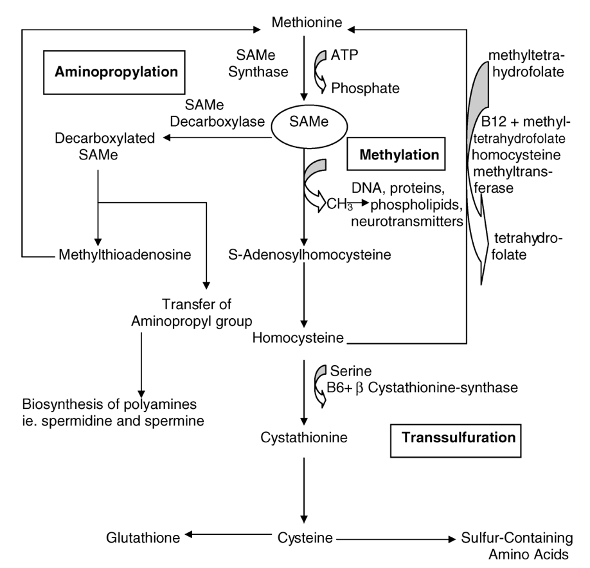
SAMe, being at the centre of one of our most essential biochemical processes, plays important roles including;
- Synthesis of tetrahydrobiopterin, an essential co-factor to produce epinephrine, serotonin, and dopamine (through hydroxylation of phenylalanine and tryptophan, which is dependent on tetrahydrobiopterin) (Parra et al, 2018)
- Supporting antioxidant support by acting as a cofactor for Glutathione-s-transferase, the enzyme responsible for the formation of glutathione, the body’s chief antioxidant
- Implications in the prevention and treatment of diseases that are driven by inflammation, such as neurodegenerative disorders (Tchantchou et al, 2008)
- Regulating transcription and translation, cell growth, and apoptosis through its role in the production of polyamines, such as spermidine and spermine, which are essential for these processes (Lu & Mato, 2012)
- Besides glutathione, SAMe aids in the synthesis of sulphur-containing amino acids through its role in transsulfuration (Blewett, 2008).
- Sulphur-containing amino acids form major antioxidants (methionine is the precursor to SAMe), therefore influence the capacity of cells to detoxify free radicals and detoxify compounds (Townsend et al, 2004)
Given that both SAMe and folate both participate in methylation and are essential cofactors for neurotransmitter production, it is no surprise that subjects who have low folate also appear to have low levels of SAMe within cerebrospinal fluid. Additionally, low levels of SAME can coincide with elevated homocysteine (by-product of SAME metabolism), which has neurotoxic implications and may be involved in the development of depression. Parenteral (administered non-orally) SAMe, at doses ranging from 150 mg to 400 mg/day has been shown to be equal to or more efficacious at treating depression than tricyclic antidepressants, with fewer side effects. Oral dosages of SAMe need to be higher to achieve the same effect as 800 to 1600 mg/day in divided doses has been shown to match the efficacy of tricyclic antidepressants (Papakostas et al, 2012).
From a nutritional standpoint, polyamines, the end products of aminopropylation (a SAMe-dependent pathway), influence DNA methylation and have a plethora of other benefits. Humans are constantly exposed to harmful stimuli, such as ultraviolet rays, free radicals, radiation, and carcinogens, just to name a few. Polyamines have antioxidant properties which can protect cells from harmful stimuli and prevent aberrant DNA methylation that can drive cancer whilst regulating DNA methylation status. Polyamines are found in basically every organism and vary widely in concentration depending on the source but germ and bran, legumes, vegetables and shellfish are all high sources of polyamines (Soda, 2022).
Given the implications of methylation in all cell processes that control genetic material, it is evident that anything that positively influences methylation will have beneficial effects in healthy aging by mitigating senescence. S-adenosylmethionine, amongst other therapeutic compounds, can be a part of anyone’s health repertoire to assist with living and aging in good health in mind which is practically the cornerstone of all health practices. Even though I have missed some nuanced points, I hope this review highlighted how important methylation is without overcomplicating things.
References
Blewett, H.J.H. (2008). Exploring the mechanisms behind S-adenosylmethionine (SAMe) in the treatment of osteoarthritis. Critical reviews in food science and nutrition, 48(5), 458-463. http://dx.doi.org/10.1080/10408390701429526
Elhamamsy, A.R. (2016). DNA methylation dynamics in plants and mammals: overview of regulation and dysregulation. Cell biochemistry & function, 34(5), 289-298. https://doi.org/10.1002/cbf.3183
Lu, S.C. & Mato, J.M. (2012). S-adenosylmethionine in liver health, injury, and cancer. Physiological reviews, 92(4), 1515-1542. https://doi.org/10.1152/physrev.00047.2011
Menezo, Y., Clement, P., Clement, A. & Elder, K. (2020). Methylation: An ineluctable biochemical and physiological process essential to the transmission of life. International journal of molecular sciences, 21(23), 9311. https://doi.org/10.3390/ijms21239311
Papakostas, G.I., Cassiello, C.F. & Iovieno, N. (2012). Folates and S-adenosylmethionine for major depressive disorder. The canadian journal of psychiatry, 57(7), 406-413. https://doi.org/10.1177/070674371205700703
Parra, M., Stahl, S. & Hellmann, H. (2018). Vitamin B6 and its role in cell metabolism and physiology. Cells. 7(7), 84. https://doi.org/10.3390/cells7070084
Soda, K. (2022). Overview of polyamines as nutrients for human healthy long life and effect of increased polyamine intake on DNA methylation. Cells, 11(1), 164. https://doi.org/10.3390/cells11010164
Tchantchou, F., Graves, M., Falcone, D. & Shea, T.B. (2008). S-adenosylmethionine mediates glutathione efficacy by increasing glutathione S-transferase activity: implications for S-adenosyl methionine as a neuroprotective dietary supplement. Journal of Alzheimers disease, 14(3), 323-328. https://doi.org/10.3233/jad-2008-14306
Townsend, D.M., Tew, K.D. & Tapiero, H. (2004). Sulfur containing amino acids and human disease.Biomedicine & pharmacotherapy, 58(1), 47-55. https://doi.org/10.1016%2Fj.biopha.2003.11.005
 Nutrition apothecary
Leave a comment